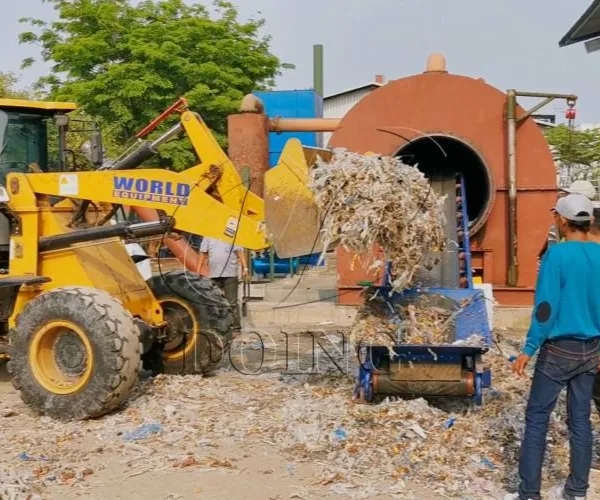
 Business License

Which Auxiliary Devices Does a Complete Tyre Pyrolysis Equipment Require?
A tire pyrolysis equipment centers on a single unit: the reactor. Even so, it cannot operate on its own. Feeding scrap tires in, handling whatever comes out, keeping the process safe and meeting environmental rules all depend on supporting equipment spread across several stages.
Comparing reactor prices alone often shows that two identical-looking reactors arrive with very different auxiliary scopes. One offer may list every part the line needs to run; another may cover only the reactor and a condenser, leaving the rest for the buyer to source later at much higher cost.
Stage 1 — Getting the tires ready
Whole tires or bales must be processed before they reach a reactor.
A tire debeader pulls the bead wire from each rim, shielding the downstream shredder from metal damage and turning the bead steel into sellable scrap. A shredder or crusher then reduces tires to a workable size. The right size depends on the reactor: some batch designs accept whole or cut tires, while semi-continuous and fully continuous designs need shredded or granular feed for their enclosed feed systems. When feed size and reactor do not match, feeding problems appear on day one.
After shredding, a magnetic separator removes leftover bead or body steel and keeps it out of the reactor — steel inside ends up in the carbon black and lowers its value. Conveyors link the steps so material flows without interruption from receiving to the feeder.
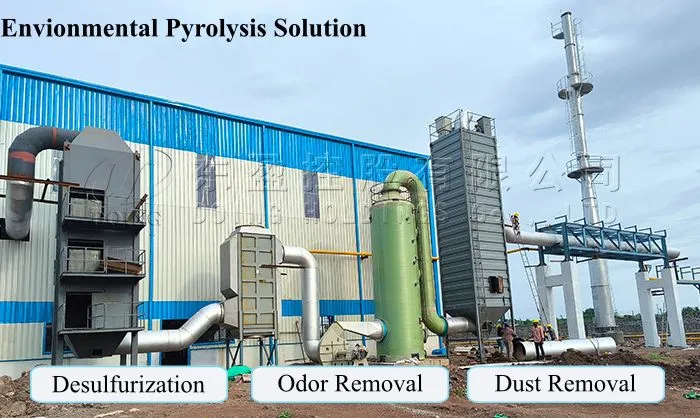
Waste treatment for pyrolysis process
Points to raise with a supplier:
· Does the price cover the shredder, or must it be bought separately?
· What feed size does the reactor on your quote call for?
· Is the debeader part of the standard supply?
Stage 2 — Feeding and sealing: keeping air out
Pyrolysis runs without oxygen. If air enters while the reactor operates, combustion replaces pyrolysis, cutting oil yield, raising temperatures and creating a safety risk.
Material enters through a sealed port. A buffer bin above the feeder holds a charge of prepared tire material and lets the operator control feed rate; a screw or ram feeder pushes material forward. The rotary airlock is the key seal — its tight-clearance blades let material through while blocking backflow of gas.
Most commercial lines use a double-lock hopper instead of a single airlock. This puts two airlock chambers in series between feeder and reactor, adding another barrier against air. A nitrogen purge fills the feeder zone with inert gas as one more protective measure — required at start-up, any time pressure drops unexpectedly, and ahead of any maintenance opening.
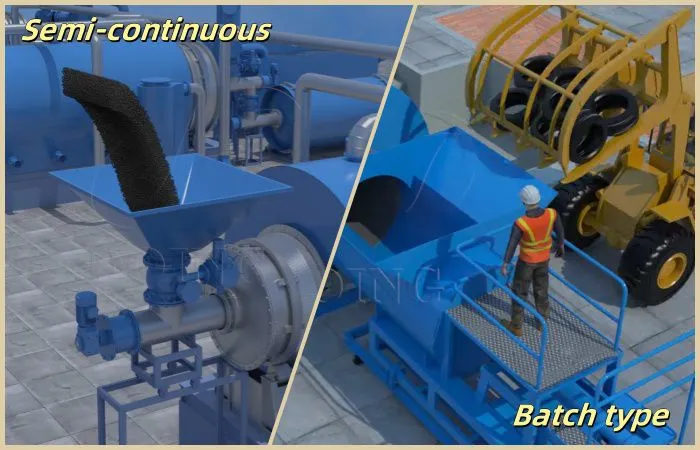
Difference between DOING ECO semi-continuous and batch tire pyrolysis equipment feeding stage
Points to raise with a supplier:
· Are all three provided — rotary airlock, double-lock hopper and nitrogen purge?
· Where do the nitrogen purge points sit — inlet, discharge and all sampling ports?
· Do buffer bin level sensors come as standard, and are they linked to the control system?
Stage 3 — Heating the reactor
A controlled heat source lifts the reactor to the temperature where pyrolysis begins and holds it through the cycle.
Whatever primary fuel the customer uses — diesel, natural gas, LPG or coal — feeds the burner. Many lines also fire the line's own cleaned syngas as supplementary fuel, trimming external fuel bills. Should ignition be lost, a flame safeguard detects it and immediately shuts off the fuel.
Temperature and pressure instruments let the operator track conditions inside. If pressure climbs too high, safety valves and rupture discs give the last protection — both are required and must be rated and certified to the vessel's design pressure. The shell is protected from the high operating temperature by a refractory lining on the inner wall.
Points to raise with a supplier:
· What are the lining's material, thickness and expected service life for my fuel type?
· Are safety valves and rupture discs both supplied? At what set pressures?
· Will the burner accept syngas as supplementary fuel? If yes, is H2S scrubbing part of the gas-handling stage?
Stage 4 — Condensing the oil vapour
Once the reactor is at operating temperature, its charge gives off a hot vapour made up of oil vapour, water vapour and non-condensable gas. This stage cools that vapour and gathers liquid pyrolysis oil.
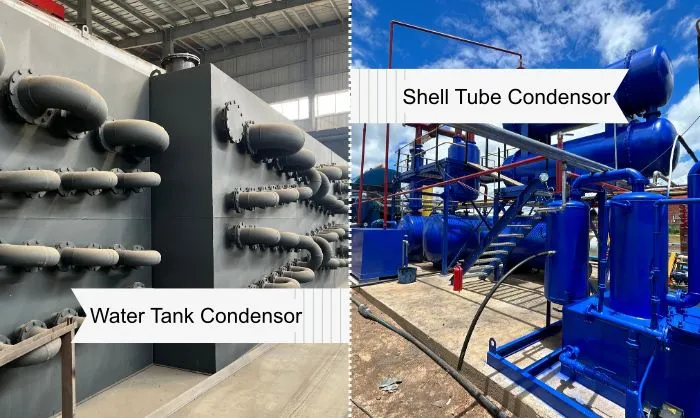
Vapour leaves the reactor through hot-gas ducting, passing a cyclone or hot filter that removes solid carryover, then enters a condensation train. Most lines fit several condensers, each cooler than the last, so heavier and lighter oil fractions condense in turn. An oil-water separator strips out water before clean oil moves to the storage tank, and transfer pumps move the finished oil to storage.
How many condenser stages are fitted matters a great deal. One condenser cannot recover all the oil vapour well. Splitting the duty across stages, with a set temperature gradient between them, captures more heavy fractions and lifts overall oil yield.
Points to raise with a supplier:
· How many condenser stages are fitted, and what are the inlet and outlet temperatures of each?
· Is a separator for oil and water part of the package? What retention time does it assume?
· Does the condenser outlet carry a demister to trap fine oil droplets before they reach the gas line?
Stage 5 — Handling the syngas
Some vapour never condenses. What is left — chiefly hydrogen, methane, carbon monoxide and a little hydrogen sulfide (H2S) — will burn. It can be used as fuel, but only after cleaning.
Before gas reaches the scrubber, a knock-out drum captures liquid carryover. Inside the scrubber, an alkaline solution of sodium hydroxide or lime strips out acidic compounds and H2S. Without that step, each burn of the gas corrodes the burner, heat-exchange surfaces and stack. A flame arrestor stops flame travelling back up the pipework, and a gas analyzer confirms safe composition. Cleaned syngas returns to the burner; unusable gas goes to a flare.
H2S removal is essential once syngas is returned to the burner. A line that flares its syngas buys external fuel all cycle; a line that returns cleaned syngas offsets part of that cost.
Points to raise with a supplier:
· Does the standard syngas scope cover H2S scrubbing?
· What flow rate does the alkaline solution run at, and how often is it checked and replaced?
· Are the knock-out drum and flame arrestor both in the quote?
· Is a gas analyzer supplied, and is its signal connected to the control system?
Stage 6 — Treating the emissions
Burner fumes and process vents must be cleaned before leaving the stack so the plant stays within local permit limits.
A multi-stage train is typical: a cyclone for larger particles; a pulse-jet dust collector for finer dust; a wet scrubber for acidic gases such as sulfur dioxide; a demister for droplets from the scrubber liquor; activated-carbon adsorption for odours and volatile organic compounds (VOCs); and a stack with sampling ports releasing the cleaned gas at the right height.
Four pollutants are commonly regulated by local permits: SO2, NOx, particulates and VOCs. Each one requires its own matching control step. A quote that lumps everything under a single ‘emissions treatment’ entry, with no breakdown by pollutant, is not a complete emissions scope.
Points to raise with a supplier:
· Does the emissions scope give a distinct control method for every pollutant — SO2, NOx, particulates and VOCs?
· What filter bag media is specified, and does it suit the particle size of the pyrolysis fly ash?
· Are the stack’s sampling ports compliant with local regulations?
· Where my permit demands CEMS, is it part of the supply?
Stage 7 — Recovering the carbon black
Drive the oil off and a solid carbon black powder is left behind in the reactor. This stage pulls it out, cools it down and gathers it.
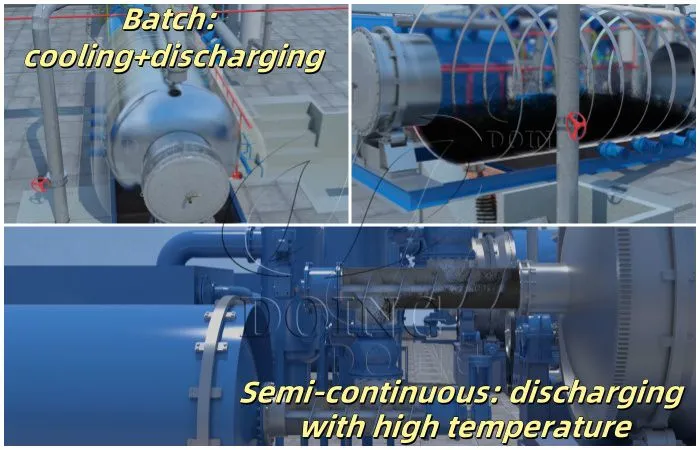
A sealed discharge screw extracts hot char without admitting air — air meeting hot char can ignite. A char cooler lowers it to a safe handling temperature, a bag filter traps fine char dust, and a magnetic separator catches leftover steel wire. The finished char goes to a silo or bagging station.
Sold as a higher-value product — recovered carbon black, or rCB — the char can be ground, classified, dried, pelletized and bagged on a separate line. Running the plant does not require this step, but it makes a large difference to what the output is worth.
Points to raise with a supplier:
· Is the discharge screw sealed at the reactor wall and water-cooled along its core?
· Is there a magnetic separator at the char discharge as well as at the feed stage?
· Does the quote include a char cooler, or assume natural cooling?
· Is the rCB line part of this quote, or a separate item?
Stage 8 — Recovering the steel wire
Each tire’s bead wire has scrap value. A magnetic separator on the feed conveyor recovers it after debeading, a wire baler presses loose wire into dense bundles, and a platform scale records the weight for accounting.
Steel also appears at the char discharge — some body wire travels through the reactor with the feed and exits with the char. A second magnetic separator here catches what the feed-stage unit missed.
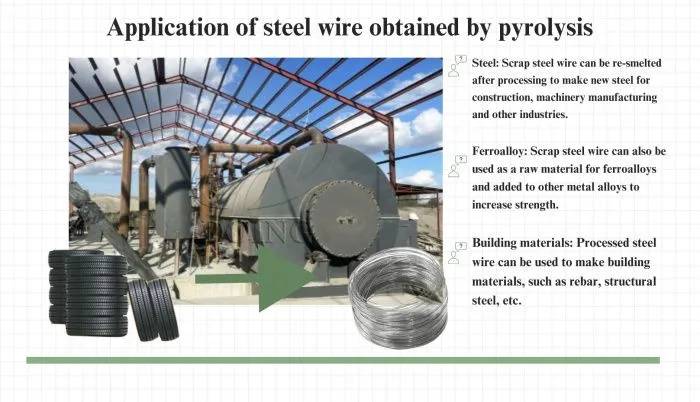
DOING ECO tyre pyrolysis production line steel wire recovery
Points to raise with a supplier:
· Are magnetic separators fitted at both the feed conveyor and the char discharge?
· What compression force does the wire baler develop, and what bale size results?
· Does the platform scale carry legal-for-trade certification for the destination market?
Site services and infrastructure
Running the eight stages described above depends on a set of base services. These almost always fall to the buyer and are the most common cause of commissioning delays.
· Power: motor control centre, variable-frequency drives on fans and pumps, and a standby generator for safety-critical loads
· Start-up fuel: diesel, LPG or natural gas for the first heating cycle, before the line makes its own syngas
· Nitrogen: for purging before the first run, during pressure upsets and before maintenance
· Cooling water: a circulating loop with cooling tower or dry cooler, plus pumps and water treatment
· Compressed air: instrument air at 6–8 bar for valves, filter cleaning and pneumatic tools
· Wastewater treatment: for scrubber blowdown, oil-water separator water and floor sumps
· Fire protection and civil works: hydrants, extinguishers, foundations, bunded tank areas and a control room
The supplier should provide a utility-consumption schedule listing water, electricity and fuel demand for each stage, so the site can be prepared during the equipment lead time, not after it arrives.
Optional additions that affect revenue
None of these is essential to run a pyrolysis line, yet each changes what the outputs are worth.
Carbon black processing. Raw char can be sold as-is or upgraded into rCB — ground, classified, dried and pelletized — for demanding markets. Where carbon black contributes to revenue, the processing line belongs in the initial scope. Fitting it afterwards would mean re-routing conveyors and rebuilding the char collection setup.
Press enter or click to view image in full size
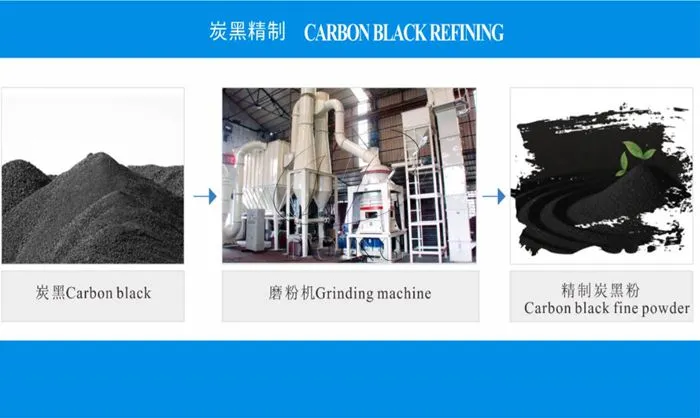
Pyrolysis carbon black refining production line
Steel wire cleaning. Pyrolysis leaves char residue on much of the wire; a simple cleaning stage removes it and lifts the scrap steel’s price.
Negative pressure system. Some lines rely on pressure difference alone to push vapour toward condensation, running at slight positive pressure. Others hold slight negative pressure and, with a Roots blower, a gas holder and a vacuum pump, pull vapour from the reactor all cycle long.
A negative pressure design does three things a positive-pressure design cannot:
· Safety: when the cycle ends and no fresh vapour is produced, negative pressure keeps drawing residual hot vapour out of the reactor instead of letting it stagnate in the hot zone.
· Product quality: vapour that leaves the reactor sooner contacts the char for less time, giving carbon black with lower ash content and better transparency — a key indicator for rCB buyers.
· Operating cost: stable negative pressure lets the pyrolysis temperature run slightly lower at the same conversion rate, so fuel use drops.
The vacuum system is interlocked with the gas-handling and cooling systems — lose vacuum and the line shuts down safely.
Press enter or click to view image in full size
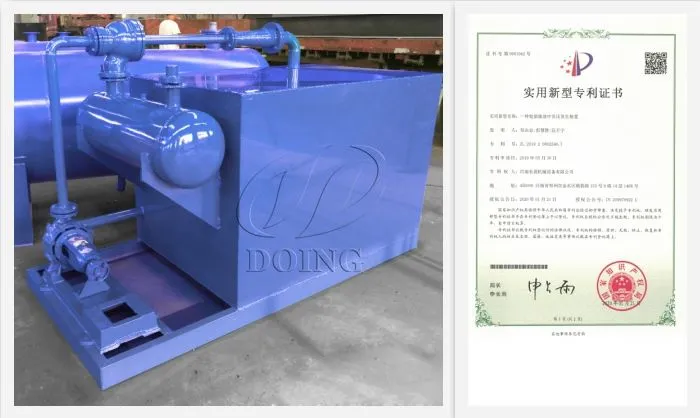
DOING ECO pyrolysis equipment vacuum device
A quick scope checklist before signing
Run through these five questions before accepting any quotation:
· Does the scope cover all eight stages — tire prep, feeding, heating, condensation, syngas handling, emissions, char recovery and steel recovery?
· Is H2S scrubbing built into the syngas stage? Send syngas back to the burner without that step and the burner will corrode over time.
· Does the emissions scope separate the pollutants — SO2, NOx, particulates and VOCs — each with its own control step?
· Does the proposal clearly separate supplier scope from buyer scope on site, including utilities, civil works and permits?
· Are a process-flow diagram, a utility-consumption list and a mass and energy balance attached?
A quote that comes down to ‘reactor plus condenser’ is not a complete pyrolysis line. Insist on the full scope in writing before you sign.
FAQ
Do whole tires need shredding before they enter the reactor?
The answer depends on reactor type. A batch reactor may accept whole or pre-cut tires; a semi-continuous reactor needs shredded feed for its enclosed screw feeder; and a fully continuous reactor needs fine rubber powder from a full pre-processing line. Confirm the required feed size before choosing a reactor, since a mismatch between feed size and reactor type is a frequent cause of poor performance in new installations.
What if the emission controls are too small?
They may clear a visual inspection, then fail an actual stack test. A quote that lists ‘emissions treatment’ without a control method for each pollutant looks complete but underperforms, and rebuilding emissions equipment under an active permit is costly. Request the design gas flow rate, the media specification and the maintenance schedule for every emissions component before you sign.
Which utilities have to be in place before delivery?
Ideally, every one of them. Foundations, power, cooling water, compressed air, nitrogen, fire protection and bunded tank areas should be finished or nearly finished before the line ships. Those who build utilities while equipment is on order begin production sooner and sidestep the typical commissioning delays.
Does a negative pressure setup justify its higher price?
It costs more upfront, and whether it pays off depends on your feedstock, product target and operating schedule. It offers three concrete advantages: lower flash-explosion risk from residual vapour at end-of-cycle; carbon black with lower ash content and better transparency; and potentially lower fuel consumption. Ask the supplier to quantify each for your conditions.
Is it better to add the carbon black processing line from the outset?
If the carbon black is for sale rather than on-site use, include it in the initial scope. Adding grinding, classification and pelletizing after commissioning means rebuilding the char collection system and re-routing conveyors, so planning it from the start is far easier.
Give your supplier your feedstock form and daily volume, product target, local emission limits and site utility status. Request a process-flow diagram, a utility-consumption list and a scope-of-supply document that names each stage and component — not one stopping at ‘reactor plus condenser.’
Recently Posted
-
Understanding Waste Disposal: Incineration vs Pyrolysis
October 10, 2026Effective waste management is a pressing global issue. Incineration, or traditional waste burning, has been a common approach but Read More
-
How to Vet a Pyrolysis Plant Manufacturer Before Buying: A 9-Point Verification Checklist
September 20, 2026The moment a deposit is about to change hands, the deciding factor is not which supplier has the slickest website but whether that Read More
-
Waste Tire Pyrolysis Machine Selection Guide: 10–15 TPD vs. 30–50 TPD
September 10, 2026Choosing the right waste tire pyrolysis machine starts with daily processing capacity, but capacity alone is not enough. Feed Read More
-
Insights into Establishing a Tire Pyrolysis Production Line
August 27, 2026The waste tire pyrolysis industry is currently attracting a feverish interest, prompting many individuals to venture into this bur Read More

Contact Us
Recommended Products
-
 DOING Newest Technology Continuous Tire Plastic Pyrolysis Machine Automatic Tyre to Fuel Oil Recycling Pyrolysis PlantUS$ 58000 - 78000MOQ: 1 Set
-
Mini to Big Scale Waste Plastic Pyrolysis Machine Recycle Scrap Plastic to Fuel Oil Pyrolysis PlantUS$ 28000 - 98000MOQ: 1 Set
-
Without Electricity Waste Tire Doubling and Tripling Machine Scrap Tyre Packing Unpacking MachineUS$ 2700 - 3000MOQ: 1 Set
-
BIG Processing Capacity Fully Automatic Waste Tire Plastic Pyrolysis Machine Waste Tyre Recycling PlantUS$ 300000 - 600000MOQ: 1 Set
-
DOING 2026 Waste Plastic to Diesel Recycling Plant Waste Plastic Pyrolysis Plant and Waste Oil Distillation MachineUS$ 38000 - 88000MOQ: 1 Set
-
Overall Services Waste Motor Engine Oil to Diesel Distillation Machine Waste Oil Distillation PlantUS$ 56000 - 105000MOQ: 1 Set
-
Latest Technology Waste Tire Plastic to Fuel Oil Pyrolysis Machine Continuous Plastic Pyrolysis Plant for SaleNegotiableMOQ: 1 Set
-
Fully Automatic Waste Tire Plastic Pyrolysis Plant Continuous Tyre To Fuel Oil Recycling PlantUS$ 300000 - 500000MOQ: 1 Set
-
Mini Scale Waste Tire Plastic Pyrolysis Machine Skid-mounted Tyre Plastic Recycling PlantUS$ 28000 - 58000MOQ: 1 Set
-
High Recover Rate Waste Oil/crude Oil/pyrolysis Oil to Diesel Distillation Machine for BusinessUS$ 56000 - 65000MOQ: 1 Set
-
Environmentally Friendly Waste Plastic to Fuel Oil Pyrolysis MachineUS$ 28000 - 98000MOQ: 1 Set
-
Large Capacity 50TPD Fully Automatic Continuous Waste Tire Plastic Pyrolysis Machine With CE CertificateUS$ 78000 - 208000MOQ: 1 Set
-
Advanced Technology Waste Engine Oil Recycling Diesel Oil Distillation Machine 80%-85% Diesel Rate Vertical Reactor Design PLCUS$ 56000 - 65000MOQ: 1 Set
-
DOING Company Environmental Friendly 100kg-50T/Day Waste Tyre to Fuel Oil Pyrolysis PlantUS$ 25000 - 500000MOQ: 1 Set
-
Very Popular With Our Customers Waste Oil Recycling to Diesel Distillation MachineUS$ 56000 - 65000MOQ: 1 Set
-
Sold to Spain High Quality and Environmental Protection Waste Tire Recycling to Oil MachineUS$ 20000 - 76000MOQ: 1 Set
-
Professional Manufacturer to Make Pyrolysis Equipment for Oil Recycling From Waste TiresUS$ 20000 - 76000MOQ: 1 Set
-
Factory Price Full Automatic 10-15 Tons PLC System Used Tire Rubber Pyrolysis Plant for Waste Plastic Recycling Fuel PlantUS$ 50000 - 70000MOQ: 1 Set
-
Fully Automatic Tire to Fuel Plant Plastic Recycling Pyrolysis to Fuel Machine Rubber Pyrolysis MachineryUS$ 50000 - 70000MOQ: 1 Set
-
Newly Technology Used Tyre to to Fuel Oil Machine Waste Plastic Continuous Pyrolysis PlantUS$ 50000 - 70000MOQ: 1 Set